
Modern companies need a new structure. The conventional pyramid-style organizational model has become a liability. A solution beyond “cross-functional ” already exists within most organizations.
The traditional hierarchy creates isolated departments, frustrated employees, and prevents companies from fully utilizing their resources, and this is a costly disadvantage in today’s business environment.
In the classic hierarchical model, companies operate under the assumption that adding up individual and departmental outputs equals overall company performance. This approach falls short because it ignores the broader ecosystem of suppliers and customers, and it blocks communication across the interconnected processes that drive real work. Worse still, departments may find themselves in competition rather than collaboration.
Wrong Measurements Drive Wrong Behaviours
When departments and hierarchical levels are artificially separated, organizational policies inevitably focus on local wins at the cost of company-wide success. People naturally optimize for what they’re measured and rewarded on—their own metrics or their department’s goals—without visibility into how these choices might harm other areas or the organization overall.
The traditional structure also creates fertile ground for office politics and individual ambition to overshadow organizational objectives. Its design encourages people to advance by outmaneuvering colleagues rather than contributing to shared goals. Career progression becomes about “moving up the ranks” rather than creating value. Capable employees may go unrecognized if they don’t serve their manager’s personal agenda and this is a devastating misuse of human potential. But does this mean we should eliminate organizational structure entirely? Not at all. We simply need to reimagine how it works.
Beyond Cross-functional – Rethinking What Organizations Actually Are
The notion of hierarchy is something we have lived with in our psyches since biblical times. When Moses’ father-in-law, Jethro, sees how Moses is wearing himself out trying to teach the law and judge disputes among the people, he explains how they can create a “hierarchy” to delegate authority, appointing captains of thousands, captains of hundreds, captains of fifties and captains of tens. This, however, was not a hierarchy of power but one of knowledge.
Science, society, and human understanding have progressed beyond outdated hierarchical frameworks. Modern research has exposed the limitations of this model. We now possess the scientific knowledge, technology, and expertise to design organizations that reflect their true nature: systems. A system, as Dr. Deming teaches us, is a network of iis a network of interdependent components that work together to try to accomplish the aim of the system. Every living system functions as a network, and we can apply this insight to enhance quality, engagement and speed of flow.
Organizations unite people with diverse skills and knowledge. When we combine these competencies effectively, we accomplish organizational objectives. Put differently, individual contributions yield collective results when we establish mechanisms that create purposeful alignment among these contributions. Organizational structure should enable this alignment. The issue isn’t hierarchy itself—it’s the type of control traditional hierarchies impose.
The Modern Approach: Coordination Over Command
Let’s revisit the key insight: the hierarchical-functional model fails because it erects unnecessary walls and obscures the reality that organizations operate through both routine and unique activities. Organizational design should instead support the systemic management of competencies and activities that are constantly initiated, coordinated across the organization, and evolving over time. There’s a specific term for this and it’s something your teams are already engaged in: projects.
A project embodies exactly this concept: an interconnected network of tasks designed to achieve a specific objective within a defined timeframe. Every project is a system. When we come to understand that a company is inherently a system, we can understand it as a network of interconnected projects. This perspective fundamentally transforms how leaders and managers operate, shifting focus toward the systematic creation and successful completion of projects that advance the organization’s strategic objectives. The right kind of hierarchy enables smooth coordination, not bureaucratic reporting lines. It goes beyond cross-functional and this dramatically streamlines management.
Technology as an Enabler
For organizations prepared to move beyond limiting hierarchical models, technology now offers valuable support. Inspired by Dr. Goldratt’s systemic approach to Project Management called Critical Chain, we developed Ess3ntial as a digital solution to help organizations operate more effectively. Ess3ntial is the first platform that allows companies to mobilize all available talent and expertise, orchestrating them as an interconnected project network aligned with company objectives. This provides a robust and effective management approach regardless of where team members are located.
The Challenge of Freedom
Abandoning outdated top-down models and embracing greater organizational intelligence and autonomy does come with a challenge. When we eliminate the barriers, the artificial limitations, and the ineffective leadership that held us back, we’re confronted with ourselves. We face the responsibility that comes with having no excuses, and the daunting yet exhilarating opportunity to explore and expand the limits of our capabilities.
Key Takeaways: Building a Better Organizational Structure
- Traditional hierarchies optimize departments at the expense of company-wide performance
- Office politics and individual ambition thrive in pyramid structures
- Modern organizations can function as networks of projects, not functional silos, to go beyond being cross-functional
- Technology platforms now enable effective project-based coordination
- Network organizations require greater personal responsibility, and unlock greater potential
Looking for ways to break down silos and improve collaboration in your organization? Discover how project-based coordination can unlock your team’s full potential. Reach out to us at intelligentmanagement@sechel.ws or through our online form here: https://intelligentmanagement.ws/contact-us/
At Intelligent Management , we’ve been helping organizations develop and implement breakthrough solutions for over 25 years. Contact us today to learn how we can help you create breakthrough solutions that take your business to a whole new level. Reach out to us at intelligentmanagement@sechel.ws or through our online form here: https://intelligentmanagement.ws/contact-us/
OUR BOOKS
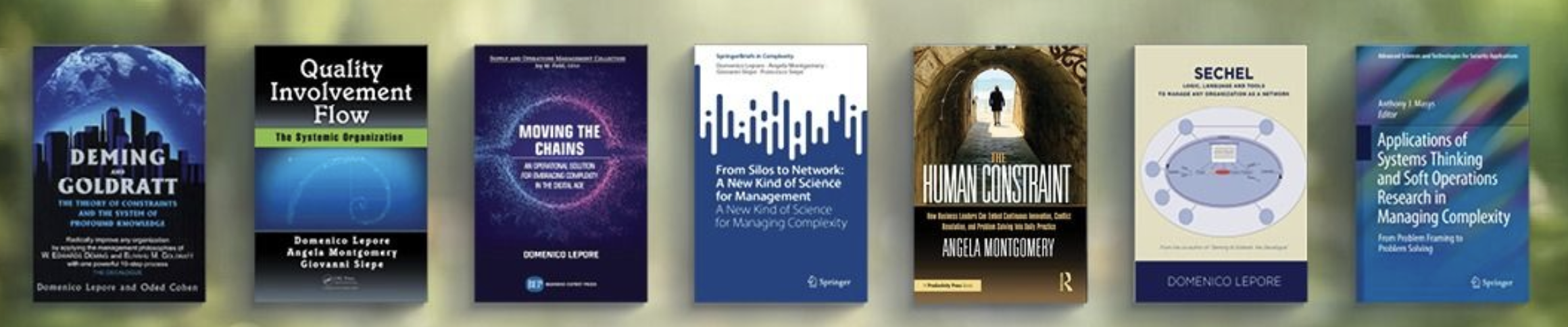
Intelligent Management works with decision makers with the authority and responsibility to make meaningful change to optimize your company for the digital age. We have helped dozens of organizations to adopt a systemic approach to manage complexity and radically improve performance and growth for over 25 years through our Decalogue management methodology. The Network of Projects organization design we developed is supported by our Ess3ntial software for multi-project finite scheduling based on the Critical Chain algorithm.
See our latest books: The Human Constraint from Routledge; From Silos to Networks: A New Kind of Science for Management from Springer; Moving the Chains: An Operational Solution for Embracing Complexity in the Digital Age by our Founder Dr. Domenico Lepore, and ‘Quality, Involvement, Flow: The Systemic Organization’ from CRC Press, New York by Dr. Domenico Lepore, Dr. Angela Montgomery and Dr. Giovanni Siepe.




Leave a Reply