“Creating the playbook will be Alonso’s first major task, after the training period. He’ll be mapping out all the process flows of the entire organization, so we can build the quality system. It’s a daunting task, but Alonso is the man for the job.”!
In this chapter, Sam tells May that she will hear a lot about the Playbook of the organization. We can define this playbook as
A clearly, indeed “super-clearly” laid out network of conversations (what everyone needs to say to everyone else to make processes work: input, output, how to measure it and how to improve it; indeed, how the process should work).
A company seen as a system is a network of interdependent processes/projects with a goal.
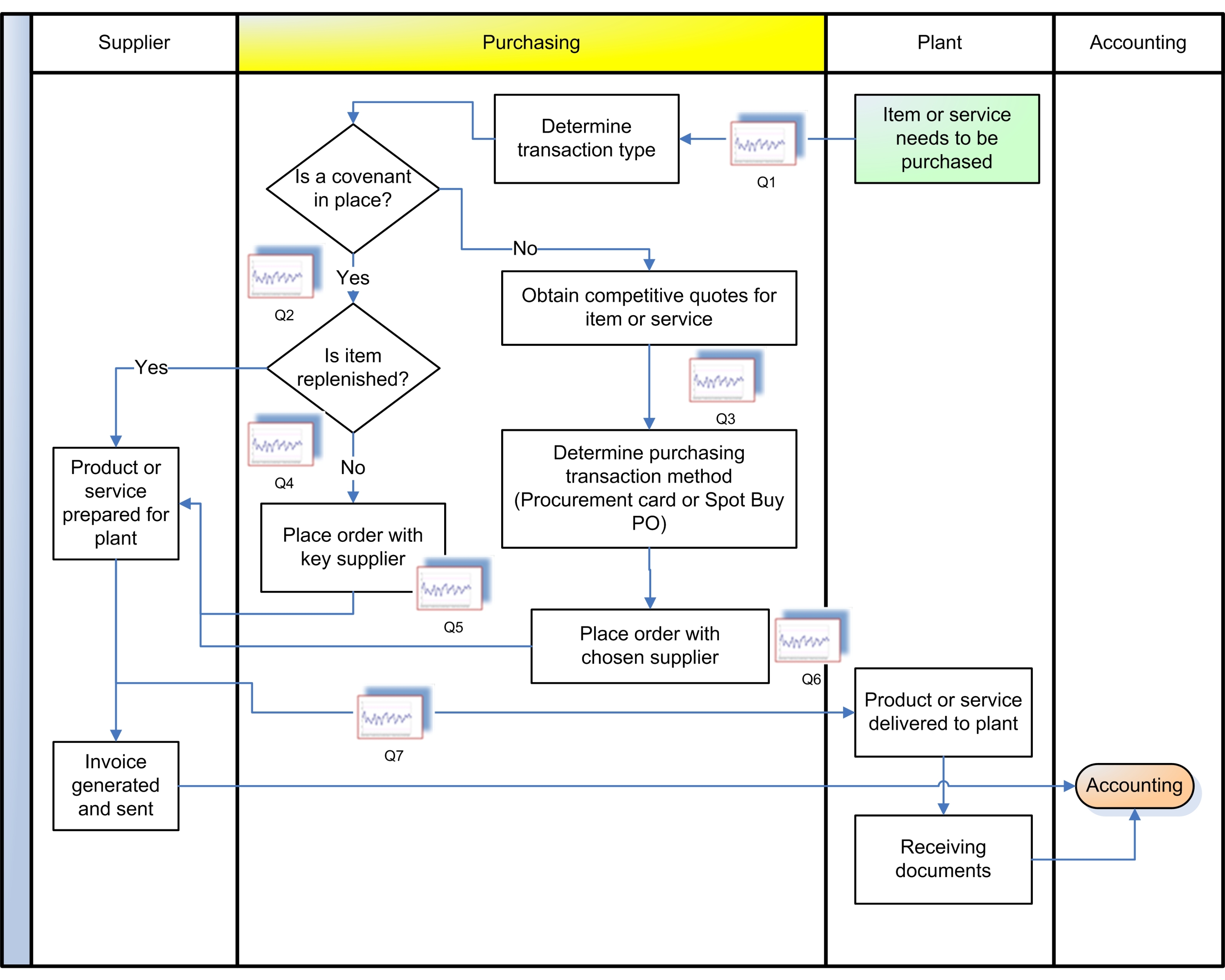
No ambition to manage a company systemically could ever be legitimate without a mechanism to ensure that everyone in the system knows where he fits into the life of the company. We call this the Playbook because in some way it resembles the collection of plays that every football player must know to win the game. Our systemic Playbook is a map that details the interdependencies/linkages, thus giving a true operational meaning to the expression “organizational design.” We are able to create this map by using Deployment Flowcharts to map out every process within the company, identifying who does what and when. Functional roles disappear. Instead, the Playbook details the network of conversations that must occur (daily, weekly, monthly, etc.) in the system in order to make these linkages effective.
The playbook is the nervous system of the organization; it captures all the connections that make the working of the company possible. The playbook is not the work of a notary and it is not carved in stone. It is the living, ever-evolving document that portrays the life of the organization. It does so at different levels by:
- depicting how all the processes are linked
- describing how these processes must be performed
- specifying which activities these processes entail and who is supposed to perform them
- illustrating the inputs and outputs of these activities
- recording the expected outcome of these activities;
- designing, validating and testing all the improvement activities and, most importantly,
- by devising all the statistical studies necessary to gain insight into the life of the organization.
Quality and Statistical Process Control are not about techniques. They are a worldview and a mindset where continuous improvement is continuous, because variation and entropy never stop. The Playbook is the practical device that embodies and enacts Deming’s PDCA cycle. It is the offspring of Deming’s vision of a company guided by the all-encompassing concept of Quality. The playbook supports steps Two and Three of the Decalogue and it is grounded in the idea of process predictability as a prerequisite for knowledge-based management. It also provides a meaningful mechanism to enhance company communication because it is based upon open and transparent information and knowledge flow. The Playbook is the open book where no personal agenda can hide. The writing up and, most importantly, the enactment of the Playbook, is not the job of a “company function”; it is the first and most important job of top management.
Example of a Deployment Flowchart