All they had to do was identify the surgeons as the constraint, i.e., the most precious resource in the surgery activities to which all other activities should be subordinated. As in any organization, it was the constraint that dictated the pace of throughput.
Organizing an organization around its constraint
In this chapter, Sam recalls the case of a hospital where waiting time was too long. Once they identified the constraint of the operating theatre as the surgeon, they were able to map out and redesign all the processes required to carry out operations and subordinate every activity to the constraint/surgeon. This enabled them to drastically reduce the waiting time in the hospital. The same concept applies to creating a systemic organization.
The systemic organization is alarmingly simple. This simplicity derives from the fact that instead of imposing a conceptual model, such as a function, in a systemic organization we reveal the way the organization intrinsically is.
In order to create an organization that combines the two most fundamental elements of a successful system as explained by the theories of Deming and Goldratt, we must:
- understand the system we are operating and its intrinsic variation;
- provide a synchronization and protection mechanism that enables its effective management.
Let’s look at what that means. Deming’s major contribution was to insist on the understanding and management of variation. Every human process, from waking up in the morning to sending a man to the moon, is affected by variation; a process can never be repeated in an identical way. Incorrectly managed variation in manufacturing, for example, leads to scrap, waste and money lost.
It is impossible to eliminate all variation because entropy exists and is intrinsic to any process. However, through statistical methods it is possible to understand variation, measure it, manage it and take actions to reduce it. This requires a mindset of continuous improvement as opposed to monitoring. In spite of the disastrous and costly effects of ignoring this reality, surprisingly few managers are conversant with Statistical Process Control.
Once we have achieved statistical predictability in our processes, we need to synchronize them and protect them from disruption. This can be done most effectively by identifying the constraint of the system, i.e. the element in the system that determines the pace at which the system generates units of the goal. Goldratt’s fundamental insight was to understand that we can manage a system by focusing on the constraint, i.e. subordinating the other processes of the system to it to ensure it works to the maximum. We protect the constraint from the impact of variation affecting the other processes by placing a buffer before it. The entire system is scheduled around the constraint using a very precise finite capacity based algorithm.
akademischer ghostwriter
ghostwriter agentur
All that matters for the success of the organization and those who work within it is speed and reliability. Our goal, therefore, is to create and manage a systemic organization based on process predictability and high synchronization of these processes. The only way to achieve this is to have an organizational structure that is built for and consistent with that very purpose. It is a structure where:
- interdependencies are clearly laid out through detailed mapping of the processes within the organization
- variation is understood and managed through relentless application of statistical methods
- a physical constraint has been identified
- a subordination process (to the constraint) is created
- a buffer is placed in front of the constraint
The constraint dictates the performance of the entire organization, therefore a minute lost by the constraint is a minute lost by the whole system. The purpose of the buffer in front of the constraint is to absorb the cumulative variation generated by the system and to prevent this variation from generating disruption to the constraint.
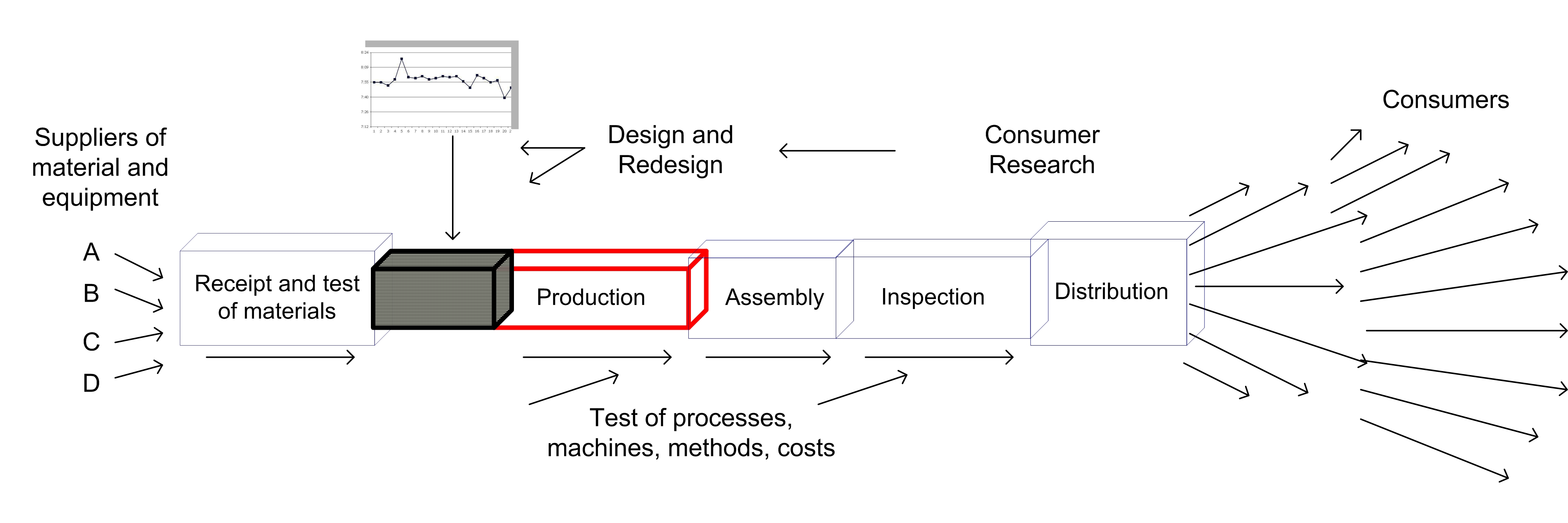
The diagram above represents a company that has been organized systemically around the constraint of Production. Statistical Process Control is used to manage variation and protect the constraint from disruption.