The more Sam worked on it, the more it became clear that the real challenge was in getting people to think beyond what they thought they knew. All the solutions they needed were already present, within their intuition, as long as they had the patience and the vision to allow the solutions to emerge. But the entire, basic paradigm of business had to shift. That was increasingly clear. His book was becoming much more that a compilation of work to date. It was an articulation of a way ahead, out of the crisis. The only plausible direction forward was to change the business mentality from zero sum game to an economy of collaboration. For that to happen, not only did the mindset and the practices have to change, but the entire organizational structure, from pyramid to network. And beyond that, for a new model to have success, they had to change the metrics. The measurement system dictated the performance, so what was needed was what Deming had called a New Economics.
What’s wrong with hierarchies and functions?
There is a blatant conflict when it comes to organizations as hierarchies:
A hierarchy fails to acknowledge three critical aspects of the life of a successful company: interdependencies, feedback cycle and the customer
For these reasons it is unsuitable for sustaining a continuous improvement effort. On the other hand:
A hierarchy seems to cater for accountability and provides a sense of control
It is clear that the hierarchical model is inadequate and prevents organizations from unleashing their true potential. Not only that, but by confining individuals within hierarchical roles, it stifles the possibility for talent and abilities to fully emerge. However, the paradigm of hierarchy is deeply embedded in within people’s psyche. No matter how uncomfortable the ‘imprisonment’ of the hierarchy might be, for many it would be more comfortable than the freedom allowed by creating the enterprise as a system. Freedom carries a heavy burden of responsibility. The traditional model for control is a hierarchical pyramid.
The reasons why a hierarchical pyramid exists is an assumption about control: individual components are more easily controlled.
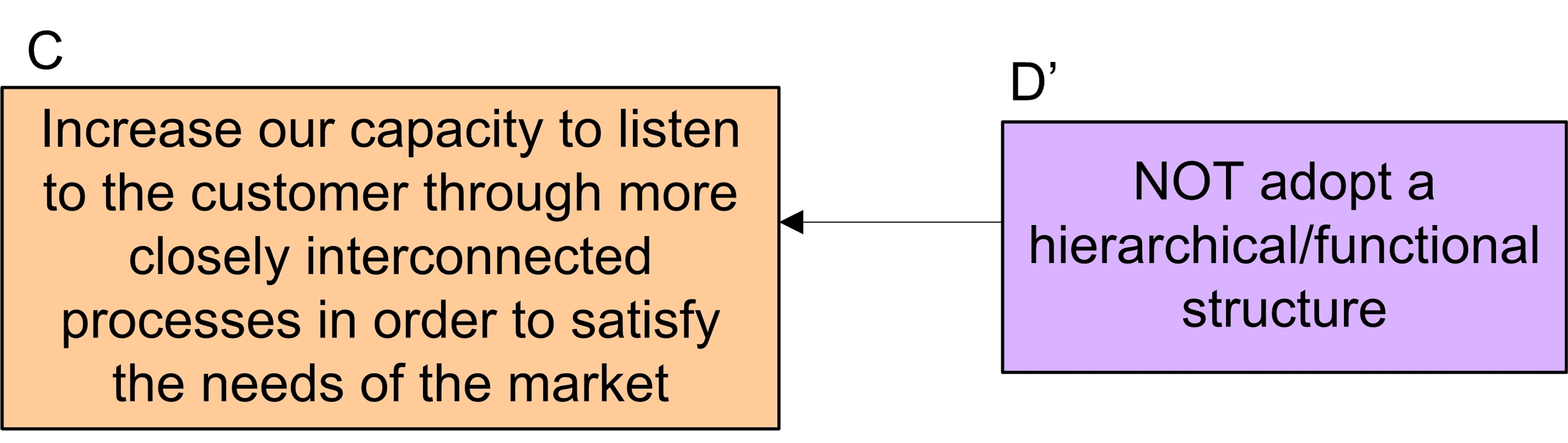
However, there are assumptions about Increasing our capacity to listen to the customer so we can satisfy the needs of the market leads us to NOT adopt a hierarchical model:
Here are the pieces of the conflict we have looked at put together:
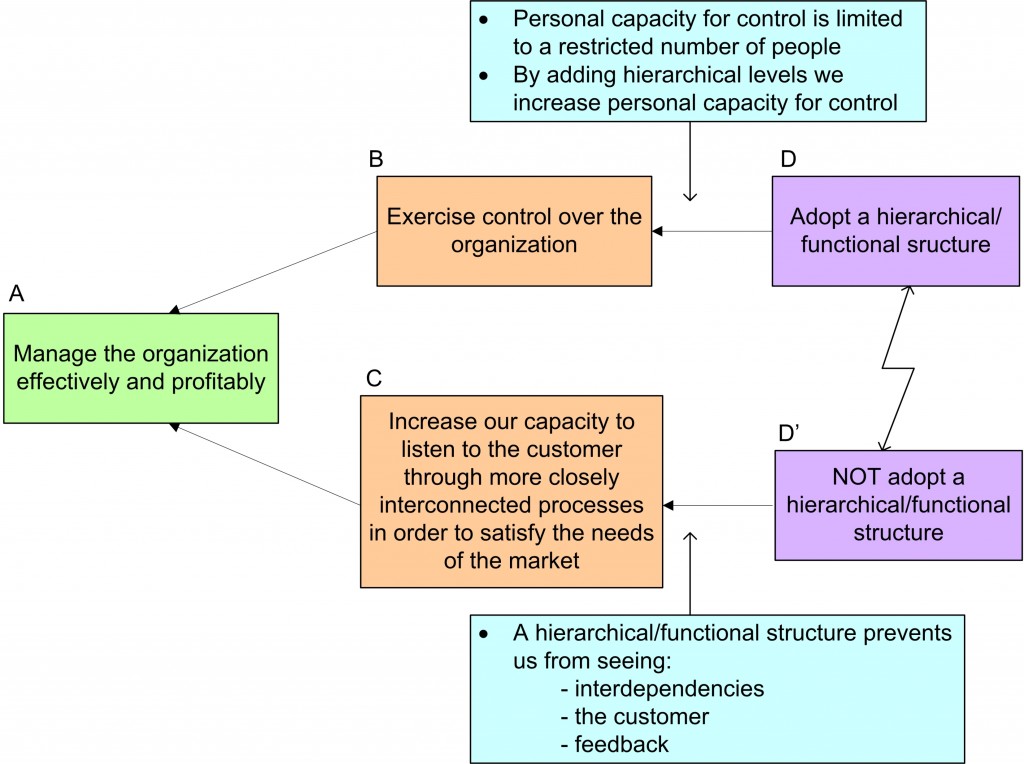
Control cloud with assumptions between B-D and C- D’
The two positions are in conflict because we believe the assumptions in the box on the right:
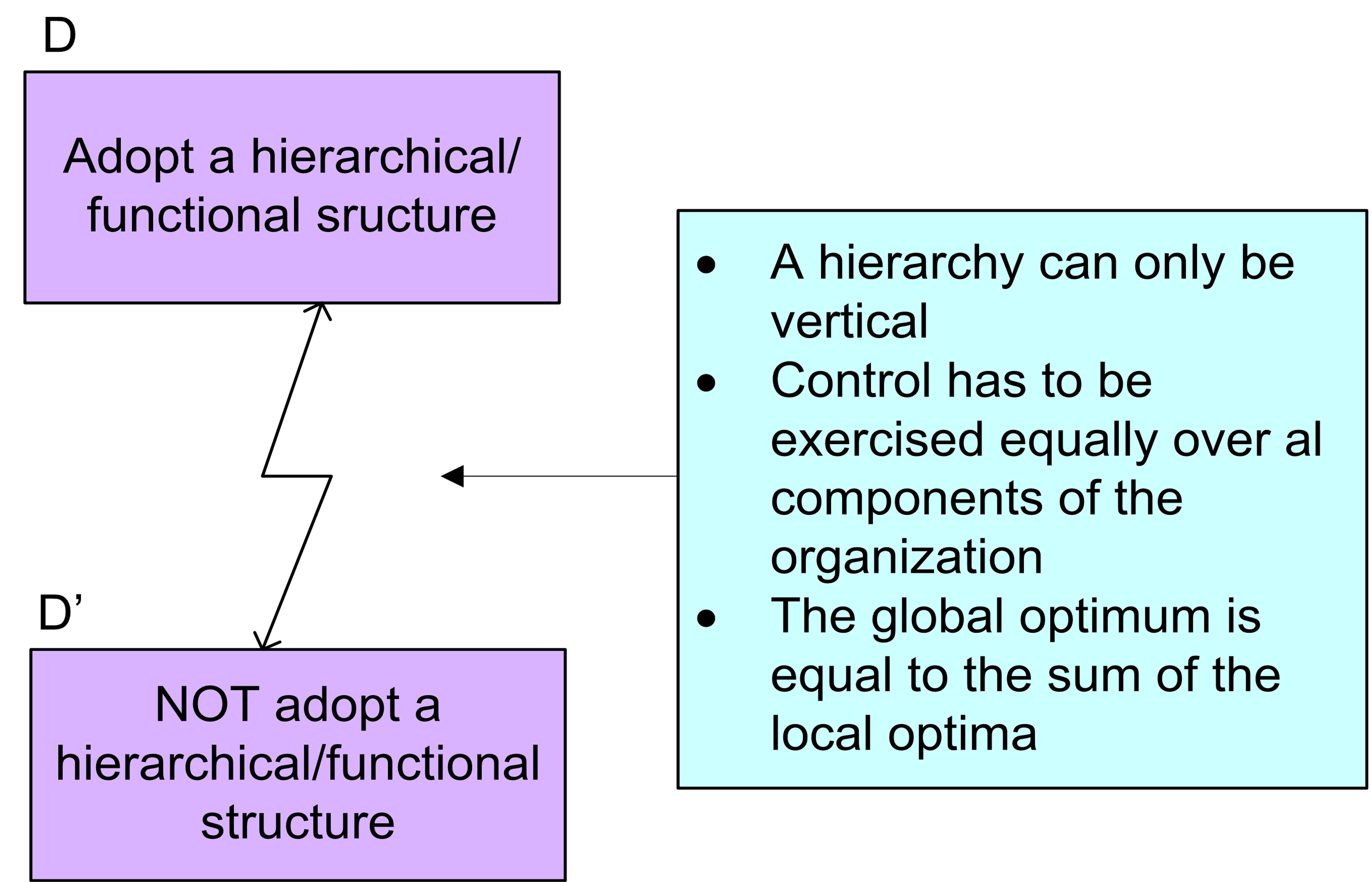
Control cloud assumptions between D-D’
The new organization: rolling out the solution of the ‘choked’ system
Excerpt from ‘Sechel: Logic,Language and Tools to Manage Any Organization as a Network’
by Domenico Lepore
In my quest to unify the work of Deming with Goldratt’s Theory of Constraints, I had developed a strong intuition for a new idea of organization: Deming’s system constrained in one point. In order to verify the validity of my intuition I had to develop an understanding of the fundamental, never verbalized, assumptions that would keep the two models in conflict; in doing so I was able to connect my findings on Deming and Goldratt to the “inherent conflict” of any organization.
So, Deming’s system constrained in one point is the injection (solution) that not only unifies the approaches of Deming and Goldratt, it re-defines the ideas of how we:
Control the system: through the constraint using buffer management and relentless application of statistical methods
Measure the performance of the system: throughput accounting
Design the system for continuous improvement: the ‘choked’ system
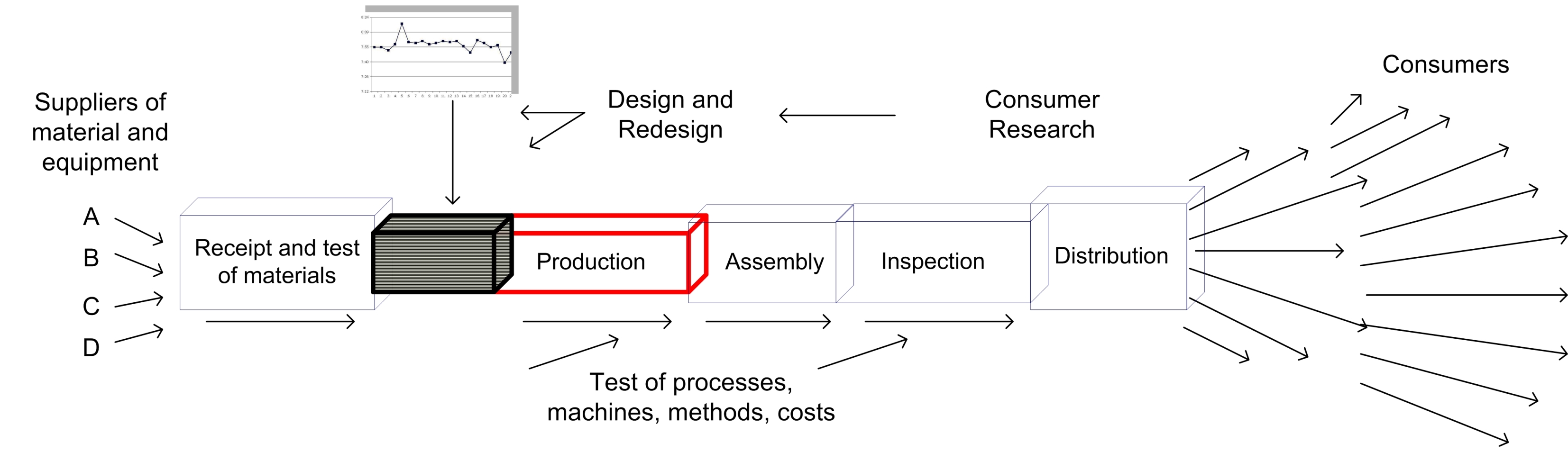
The ‘choked’ system
The understanding provided by this injection was in need of a massive dose of knowledge in order to be transformed into a reality. The ten steps forming the Decalogue were the answer Oded and I came up with. This was the algorithm for creating and managing a systemic organization that is Deming’s system constrained in one point.
We tested the Decalogue logically for validity using the Thinking Process tool called the Transition Tree. The validation of this algorithm gave us confidence in the sufficiency of the solution.
In our book Deming and Goldratt: the Decalogue we fully describe the ten steps and how they follow the pattern of the PDSA cycle. This cycle firmly embeds the scientific method within the application of the steps. This was only the beginning of a ten-year journey applying and verifying the validity of the solution. At the end of Part Two of this book (‘Sechel: Logic,Language and Tools to Manage Any Organization as a Network’) we outline the ten steps. Through the examples provided in Part Three we offer further elucidation on the implementation of the steps and how they can contribute to increasing manifold the performance and continuous improvement of an organization.