Alonso’s patience and calm were his greatest assets as every day, the number of maps multiplied, and day after day, he coached people through the cognitive leap from “this is the way we do things here” to “let’s look at the process and work out how to improve it.”
All of the maps, all of the processes dutifully flowcharted and revised, were being compiled into one central document that they referred to as the Playbook. The mass of lines and arrows and checkpoints was multiplying and growing, gradually generating the central nervous system for Maidenhead. Thanks to the knowledge contained in this document, they were gaining the ability to synchronize the efforts of the entire organization towards their goal. There would be a precise and steady beat to which they would receive material, process it and supply it. Inputs and outputs. Then everything had to be closely monitored, a finger had to be kept on the pulse of the operations through the continuous production of statistical process control charts. Variation had to be closely watched over and managed. The central point of focus would always be the constraint they had chosen, and that was the speed of replenishment. Everything else would have to subordinate to that.
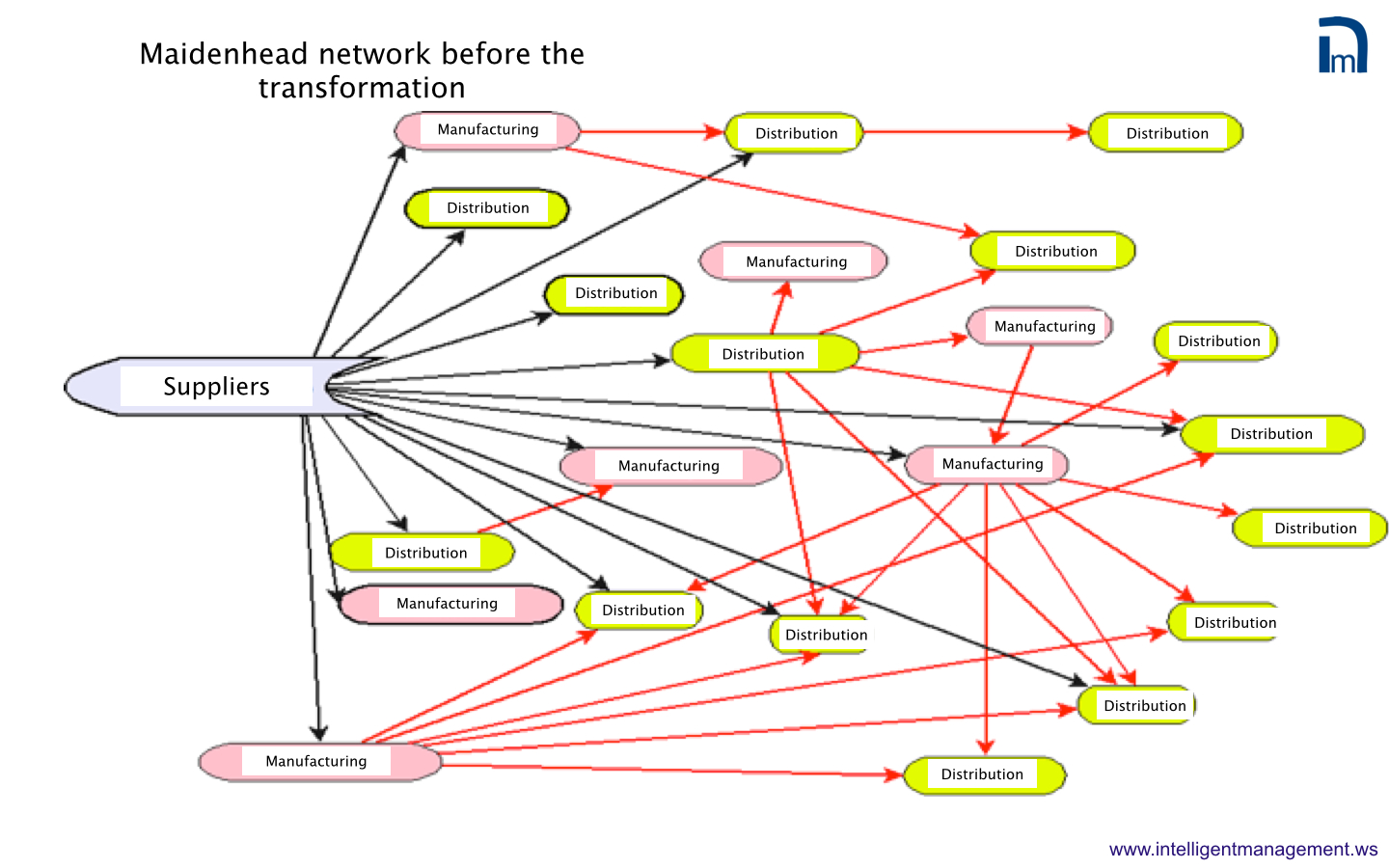
When Nick, Sam and the TPK Holdings team start working on the system at Maidenhead Metals, they found a completely fragmented organization, with a number of separate entities, all working independently. See below.
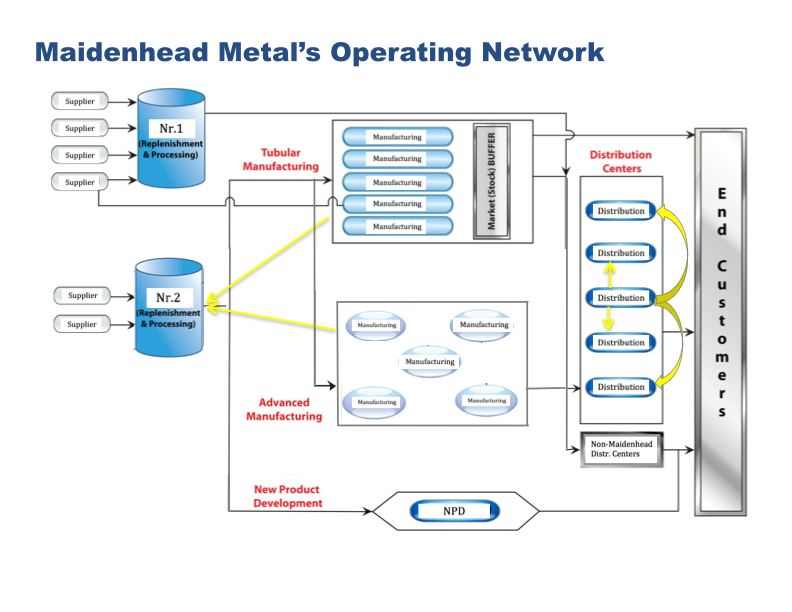
After working to create a unified system, where the flow among the various components of the network is optimized around the constraint of replenishment, the network takes on a whole new appearance. See below:
An Organizations is a System
The work of an organization and the way it interacts with its environment are systemic in nature. In other words, the organization viewed as a system is not an ‘invention’ but rather a ‘discovery’: it is the unveiling of something that is structurally inherent to the life of any organization. Organizations, therefore, need to be considered as systems. The conventional Hierarchical/functional organizational chart is far from adequate to portray what an organization should do and how it should work.
The most fundamental feature of any system is the way its components (its processes) interact and are interdependent with each other in the pursuit of a stated and agreed upon goal. This creates a network of interdependencies and this network shapes and determines the possibilities of the system towards its goal.
Leading the System
The most effective way to manage the performances of a system is through the understanding of the variation of its processes. Such understanding must be statistical. Hence, managing a system means, in essence, managing its variations. Any meaningful leadership can only be originated by a profound understanding of the nature of process variation and its impact on the system and its environment. A leader must strive to ensure statistical predictability everywhere in their organization in order to allow meaningful managerial decisions.
Coordinating the System
The performances of a system made up of processes with well understood variations can be greatly enhanced if we determine one element to be its “physical” constraint. In such a variation-managed, constrained-based system the performances of the whole are essentially linked to the performances of the constraint. A new measurement system is required based on Throughput, Inventory and Operating Expense and their basic interrelations. The Decalogue provides a simple algorithm and a guideline to guide the management of such a system.
What is the most logical and practical way to coordinate the work of a constraint- based system? In other words, how can we proficiently organize the network of interdependencies making up our organization? What is the organizational structure most suitable to sustain the systemic endeavour?
Such a structure is a multi-project environment. Any organization that accepts the idea of system will find in the ‘network of projects’ the organizational structure that most naturally leverages the power of a system.