 Bear Stearns Building, Madison Ave. NY*
A different kind of Project Management
“They also have a different way of managing the projects. I’m not familiar with project management beyond managing my own assignments, but I’m learning so much even about that. As I understand it, most projects finish late because of things like procrastination, bad multi-tasking, and inaccurate prioritization. Another major problem in projects is people trying to cover their ass. So when they get asked for a time estimate they pad it out. Here, instead, people are asked for realistic estimates because a time buffer is placed at the end of the project, instead of adding padding to each task. This protects the whole project, and this way, when people finish early it speeds up completion. It’s called ‘Critical Chain’ and that’s because you identify the critical tasks that determine the completion of the project, and only assign available resources.””
At Maidenhead Metals, the kind of Project Management approach they use is called Critical Chain. This approach was developed by Dr. Eliyahu Goldratt, and it has been used with great success around the world, including large scale military applications.
Dr. Goldratt describes this approach in a business novel called ‘Çritical Chain’. This book is a very intense, heartfelt and sometimes abrasive novel. In this deceptively simple and fast-paced book, Dr. Goldratt throws down the gauntlet to academics and industrialists alike on what it takes to use knowledge to achieve results. Critical Chain is not just a way to manage projects. It is the offspring of a vision of the world. This often gets lost when people get too bogged down in the wealth of practical details associated with its implementation.
Project Management and mindset
Looking at Critical Chain as a technique for managing projects means essentially missing the point. The reason why, after thirteen years of relentless efforts to disseminate Critical Chain, tools like Microsoft Project still dominate the way projects are “managed” is that any attempt to use Critical Chain without embracing a purely systemic view of the organization is doomed to failure.
Critical Chain represents the embodiment of a vision of the organization based on pace of flow, people’s involvement and great emphasis on quality. Quality, involvement and flow are the basic philosophical pillars of the systemic organization.
The issues of delay and burgeoning costs that plague the majority of projects can be overcome through the Critical Chain algorithm that is central to the Theory of Constraints and the Decalogue management methodology.
A summary of the main tenets of ‘Critical Chain’
Wrong behaviours and mind habits like multitasking and putting issues off until the last minute (“Student Syndrome’) slow down artificially the completion of projects;
Our minds are not trained to assess risks associated with probability distributions;
We must not protect individual tasks but the project as a whole – no milestones;
The traditional Critical path method for scheduling projects often creates resource contention;
Resolving this resource contention leads to a very different series of dependent events that determine the length of the project; we call it Critical Chain;
It is this chain that we protect with a project buffer that absorbs the covariance of the project;
Non-critical branches, called feeders, are also protected with a cumulative buffer”(not individually) placed at the end of the “feeding chain”;
If we manage several projects in parallel, we must select a finite set of resources called “pacing resources”; they will dictate the pace at which the organization as a whole is capable of achieving its goals.
Project Management and variation
The technique of Buffer Management is not only used to protect the constraint in the case of a manufacturing or production process. Every time we have finite resources, and this is always the case, we have to manage and protect the ‘finite capacity’ available. In project management we are faced with the problem of completing the project successfully within an established timeframe and within a precise budget.
The approach to project management in the Decalogue is a ‘systemic’ approach. We have already said that a system is a set of interdependent processes that work together to achieve a goal. A project is a set of interdependent tasks, which must be carried out within precise specifications; hence, a project is a system.
We start by trying to define the limiting factor of the project, its constraint, in order to understand how to manage and protect it. We give the name Critical Chain to the longest sequence of dependent events taking into consideration the sharing of resources. This sequence determines the length of the project, and this is the limiting factor (constraint) of the project itself.
There is a ‘cognitive constraint’ that characterizes project management that is basically dictated by the inability to understand how to buffer the project in order to be successful.
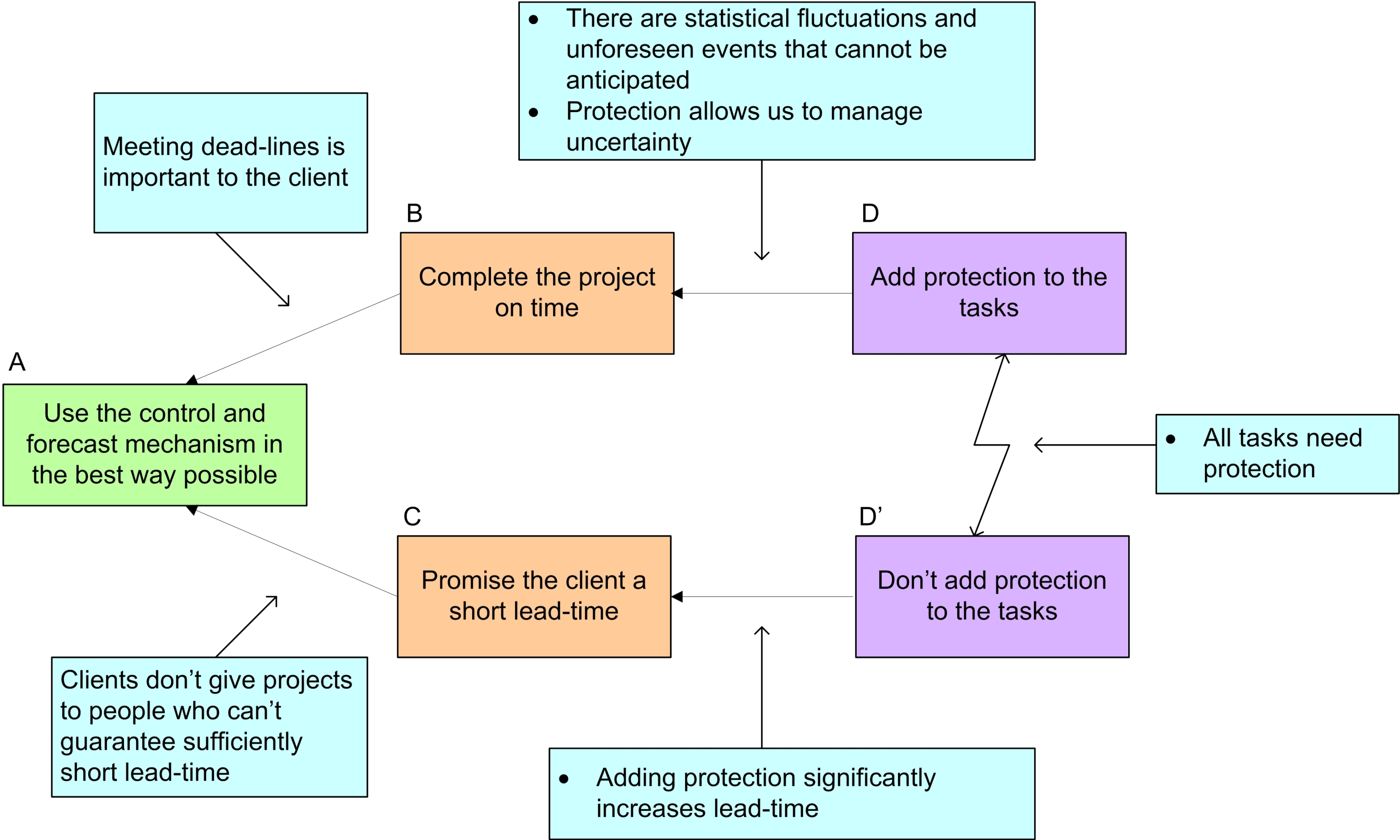
Project Manager’s cloud
The injection to this cloud is the ‘project buffer’.
The project buffer provides us with the injection “add protection only to the sequence of tasks that determine the length of the project”.
Instead of protecting every single task in the critical chain the protection is accumulated at the end of it in one buffer, the project buffer.
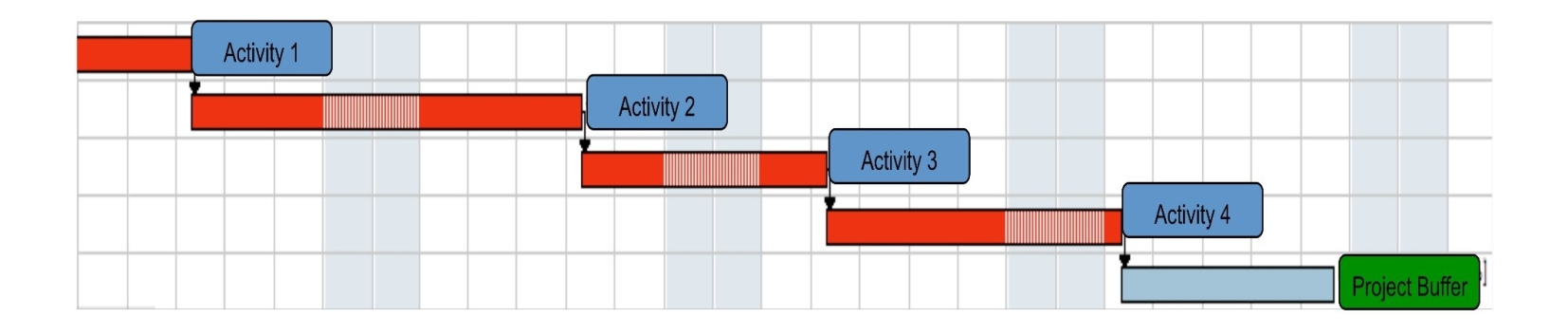
The project buffer
The question is now how to manage the buffer. A system is stable if it produces predictable results, and the ability to predict is the true essence of management. What really matters here is: is the system stable? There is a simple and powerful mechanism that can answer this question. It is called buffer management.
If the processes that influence the buffer are not stable, we cannot decide on the amount of protection (sizing of the buffer).
The buffer becomes a control mechanism only if the processes of the system are in control and consumption of the buffer oscillates in a stable way with an upper limit that is inferior to the maximum width of the buffer.
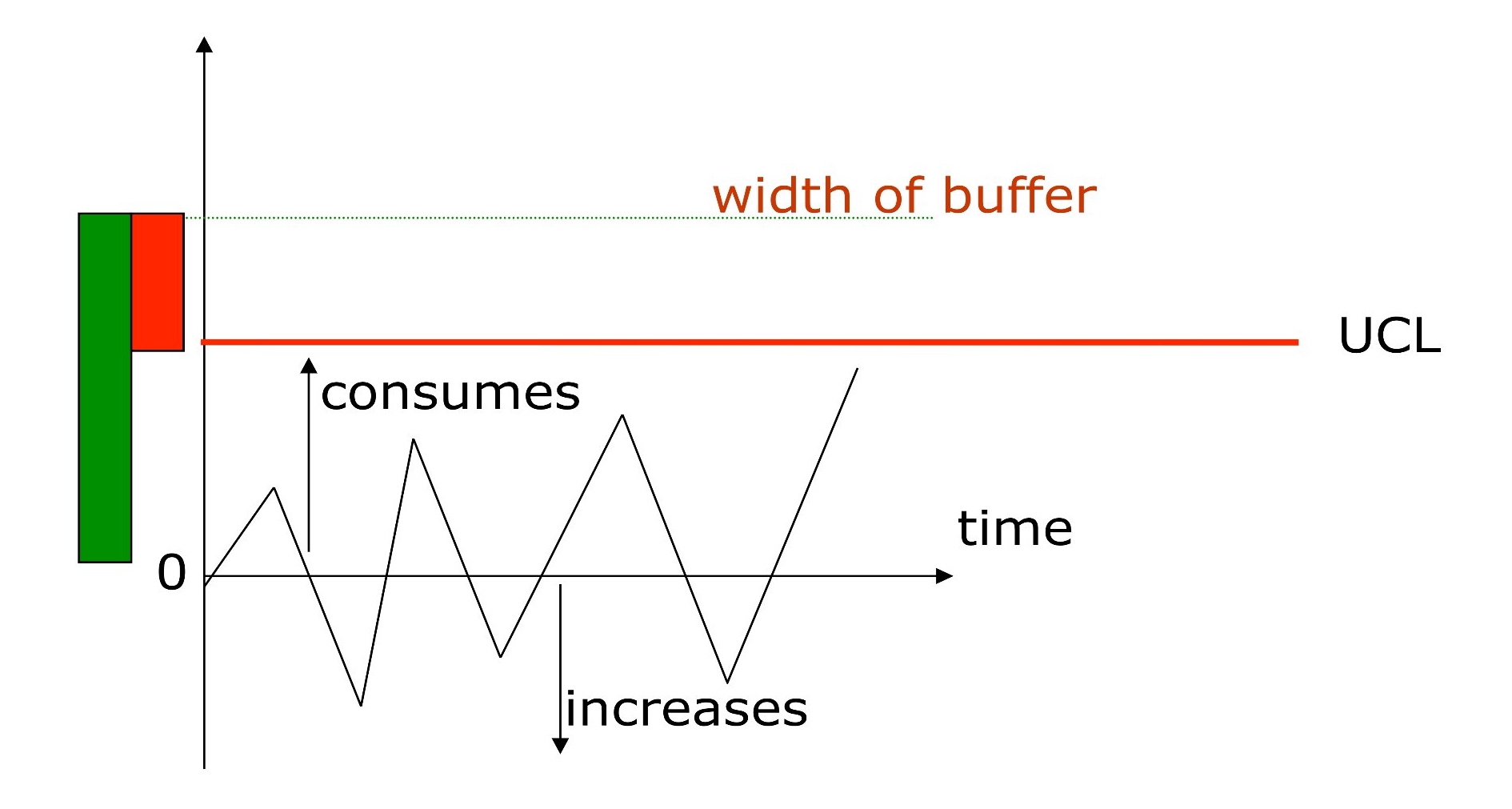
SPC has a large variety of applications but, as Dr. Deming said, it is a ‘way of thinking’. Becoming accustomed to this way of thinking is not easy, and requires a great deal of effort, as does acknowledging the existence of variation. As strange as it may seem, the majority of people do not take variation into consideration at all, and they perceive any change in processes as something ‘good’ or something ‘bad’. If you compare two numbers you will always have one bigger than the other, or equal. With SPC we have the possibility to compare two numbers and understand that they are generated by the same process, and that any difference is due to one thing alone: entropy.
Managing the inevitable increase of entropy to maximize throughput is the only possible goal for a manager.
*Image by David Shankbone at en.wikipedia (Transferred from en.wikipedia) [CC-BY-2.5 (http://creativecommons.org/licenses/by/2.5)], from Wikimedia Commons