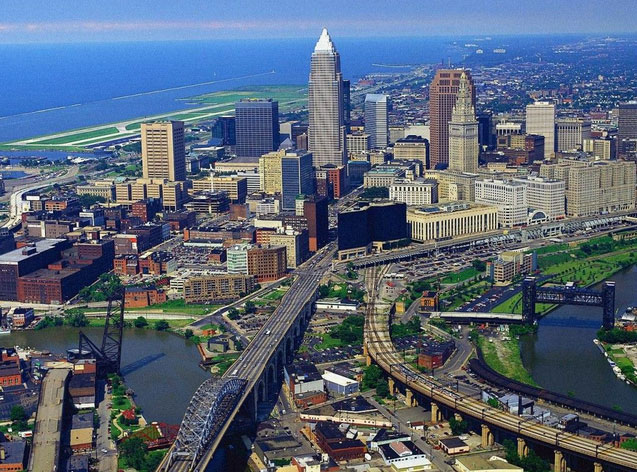
Cleveland, instead of being one, great city, was divided up into sub-cities, with fractioned off services, and an east-west divide that went far beyond topography. In a similar way, Maidenhead Metals, it appeared, was far from being one whole entity. Instead, it was a collection of companies that acted as if they were all separate. It was a situation of artificial complexity, and what the TPK people needed to do to was already complex enough.
What does complexity actually mean?
“Complexus”, the Latin word for “complex”, roughly means “twisted together”. In other words, when several elements come together and interact, they form a “complex system” . Complexity is an intrinsic feature of life in all its manifestations. From the biological aspects addressed by life sciences to the cognitive and behavioral aspects originated by human relations.
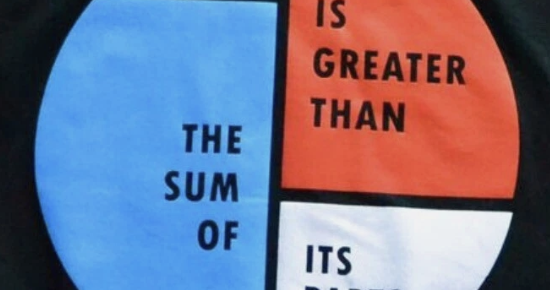
These interactions are highly non-linear. That means they produce properties that may not belong to any of the individual components; in other words, the system created by these interactions can be very different from its components and cannot be understood in terms of those components (the whole is greater than the sum of its parts).
That is why it is a big mistake to try and tackle complexity by cutting things up into their smaller components. You can’t divide complexity up into bite size chunks. This leads to a complete misunderstanding of the phenomenon at hand because it ignores the interactions. We need to be able to see the interdependencies in a complex system in order to manage them.
How do we understand complexity?
For organizations, understanding interdependencies means understanding the most suitable ways to orchestrate people’s work. The job #1 of a CEO is to design the correct interdependencies among their people.
They need to design the most appropriate network of interdependencies to accomplish the goal of the organization. The Organization’s processes are the links in the network that transform inputs into outputs.
How do we manage complexity?
Deployment Flow Charts are useful tools. They allow the visualization of “who-does-what-and-with-whom”, hence making clear the “metabolic” process of the network.
The gigantic contribution of Dr. W. Edwards Deming to the science of organization was his unique understanding of the role that variation plays in the management of interdependencies. We can map out interdependencies with Deployment Flow Charts and monitor and manage variation with Statistical Process Control (SPC). These two tools form the backbone of a systemic approach to management.
Managing an organization around a strategically chosen constraint drastically improves focus by subordinating the system to the constraint. The Thinking Processes Tools devised by Dr. Goldratt within the Theory of Constraints help us visualize and understand cause-effect relationships in complex environments. These tools are powerful aids to managing variation in human relations. They take complex problems and trace them down to a root cause.
Rethinking organizations for complexity
Management is the science that studies how to create and guide human relationships within the framework of an organization, i.e. a well-defined realm of human relations and interactions. Understanding these interactions today involves re-thinking conventional, silo-based organizational structures and creating systemic structures.
Complexity, then, becomes for us the field of knowledge that examines how we can produce long-term, sustainable results and contribute to the betterment of the larger systems we are part of within a suitable organizational structure (a system of interdependencies aimed at well defined goals).
In other words, complexity is about how organizations can produce economic results within the framework of a human-centered, ecologically-minded vision of the world. Don’t cut through complexity. Understand it, embrace it and leverage it.
Below, we have framed the concept of managing complexity with a conflict cloud.
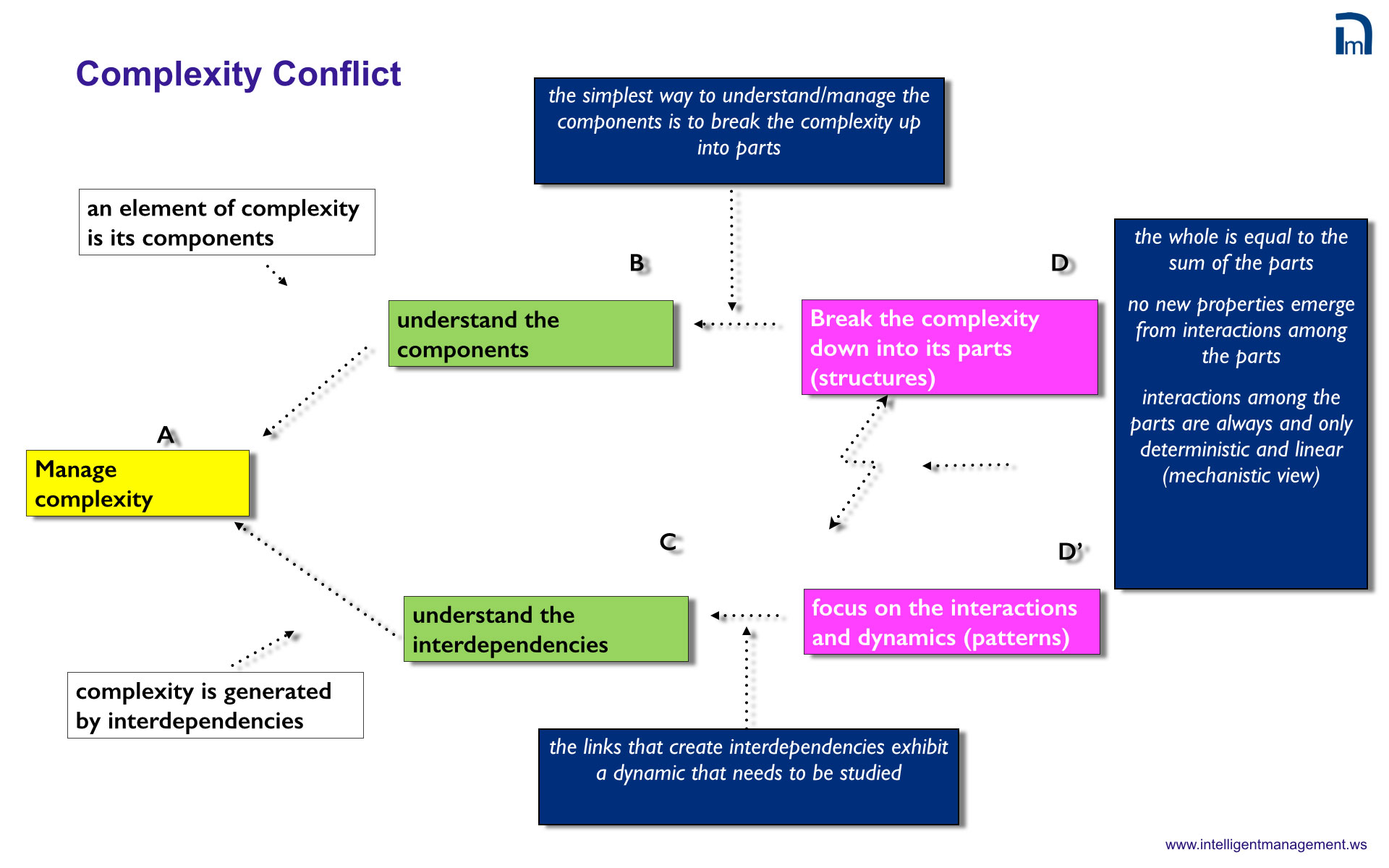
The conflict between the two pink boxes rests upon the assumptions (mental models or limiting beliefs) listed in the blue box to the right of the pink boxes. These are the assumptions we need to invalidate to find a breakthrough solution. The solution must respect the two legitimate needs in the green boxes. We believe that solution lies in adopting a systemic management approach as described throughout this book.
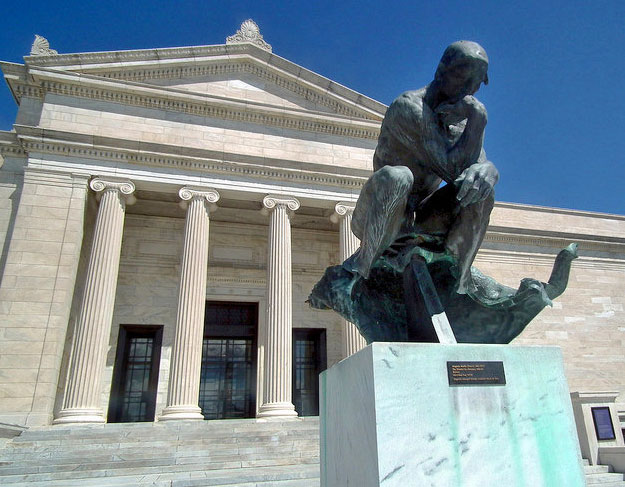
The entrance to the Cleveland Museum of Art.
The cast of Rodin’s iconic ‘The Thinker’ outside the museum in Cleveland was damaged by a terrorist bomb in 1970. It was decided not to repair the damage. Rodin originally designed ‘The Thinker’ as one of the main characters from the hell of Dante’s poem ‘The Divine Comedy’. This was part of a commission for a set of doors for the Museum of Decorative Arts in Paris that was never built. The Thinker was originally supposed to represent Dante himself.